
Padel rules for your first match: serving, walls and scoring
Get ready for your first padel match with a serving diagram, scoring example and simple explanations of walls, returns and match formats.
Your first padel match can involve more questions than shots: where to serve, when to let the ball reach the glass and what everyone means by “deuce”. Learn the recurring situations first, then ask your group about anything unfamiliar.
Start with three ideas: serve diagonally, let the return of serve bounce, and remember that a wall does not replace a floor bounce. Agree on scoring and what happens at the end of your court booking before the match starts.
This is an introduction for recreational players. For competition, follow the organiser’s regulations. The International Padel Federation’s 2026 rules include different scoring methods, so check which one your match uses.
How to serve in padel
Bounce the ball and strike at or below waist height into the diagonal service box. You have two attempts. The receiver must let it bounce. A correct bounce followed by glass is playable; hitting the mesh before a second bounce is a fault. A net-touching serve that lands correctly is replayed unless it commits that mesh fault. Hazlemere Tennis & Padel Club’s guide.
FIP requires the bounce and ball before contact to remain in the serving area, without stepping on its prohibited lines. Keep at least one foot grounded at impact. FIP rule 6.
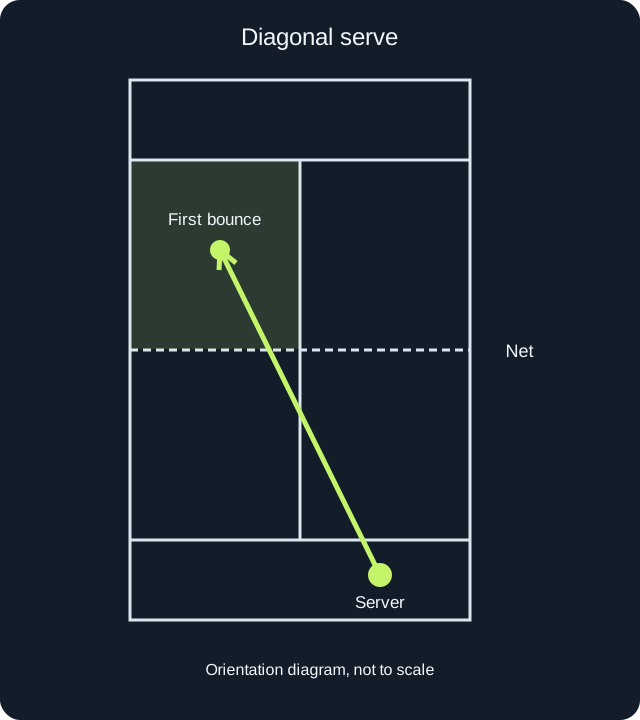
An orientation diagram for the first serve of a game. The arrow shows direction, not ball height or a compulsory receiver position.
Before hitting, stand behind the line and point out your target box to a partner. That separates finding the direction from playing the shot. For a first match, getting a rally started is a useful goal in itself.
When you can use the walls
During a rally you may volley or play after one bounce. A ball that bounces in your court then hits glass or mesh remains playable before a second bounce. Sending it straight into the opponents’ enclosure loses the point. You can return via your own glass, but not via your own mesh. Barnton Park LTC’s playing guide.
Try this before playing competitively: ask a partner to send a gentle ball towards the back of the court. Watch the sequence and say what happens: floor, wall, rebound. You are learning to recognise the order without simultaneously trying to win the point.
Do not chase a ball outside the court just because you have seen a professional do it. Ask what the facility permits and what space is available. For your first session, agree how you will pause and consult the rules when a situation is unclear.
A scoring example you can follow
Traditional scoring goes through 15, 30 and 40. From deuce, a team needs advantage and another point. A usual set requires six games with a two-game margin; at 6-6, play a tie-break. The LTA’s introduction.
Here is an invented sequence. Read the serving team’s score first:
| What happens | Game score |
|---|---|
| Serving team wins the first point | 15-0 |
| Receiving team wins the next point | 15-15 |
| Serving team wins the next two | 40-15 |
| Receiving team wins the next two | 40-40, deuce |
Call the score before each serve. If someone disagrees, settle it before starting the next point. Saying it aloud makes keeping track a shared task instead of leaving a beginner to silently reconstruct the game.
Advantage, golden point and Star Point
Ask how the group resolves deuce. Golden point uses an immediate deciding point. Star Point allows two advantage cycles, then a deciding point if the score returns to deuce a third time. FIP 2026 scoring, rule 1.
In Argentina, you can ask: “¿Jugamos con ventaja, punto de oro o Star Point?” Do not introduce an unfamiliar method midway through a game. Choose something all four understand; at a tournament, use the organiser’s announced format.
Agree on the end of the booking
A booked court slot and a completed match are different things. For a friendly game, agree what happens when your time is nearly up: finish the game if time allows, record a partial score or continue another day.
Avoid inventing a new finishing rule once one team is ahead. If you want a final tie-break, plan for it and remember it can run long too. Leave the court ready for the next booking.
Change ends after odd-numbered games and every six points in a tie-break. FIP rules.
Useful Spanish and a first-match checklist
You may hear saque for serve, resto for return, iguales for deuce and ventaja for advantage. A turno is the court’s booked slot, not a set. Ask someone to repeat the score if you lose track of the language.
Before entering:
- Tell the group this is your first match and ask for help with scoring.
- Check equipment, finish time and who is bringing balls.
- Establish who serves first and which side you receive from.
- Agree on the deuce format and what happens when time runs out.
- Ask about an unclear rule before arguing over the result of a point.
If you still need a group, read how to choose a match at your level in Argentina. You will have a better chance of learning comfortably when the other players understand your experience.
Common questions
Do I need to know every rule before starting?
You can arrive at an introductory lesson or beginner session with questions. Tell the organiser in advance and choose a setting where someone can explain. Use this guide to prepare; understanding the pace and decisions of a match also takes time on court.
Should my first experience be a tournament?
Check who the event is for and what experience it expects. If you need frequent help with serving and scoring, a lesson or introductory friendly gives you room to practise without the demands of a competitive draw.
FaltaOne is being prepared to help players find suitable matches. See how it will work, and start with a group that gives you space to learn the game.